The map of the M.I.A. also stated that there was a Van Gogh, so while still in the Impressionist wing, I decided to look for it.
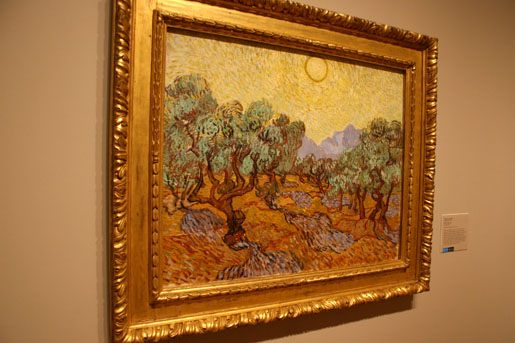
As I sauntered down the gallery, past landscape and pastoral scenes, I ended up somewhere in the ornemental silver section, alongside some statues, too. I was curious as to how I got turned around, but then I turned around the way I came. Back in the gallery with the Manet, I found that the far wall had, in the centre, a modest, yet commanding painting. It was Olive Trees, by Vincient Van Gogh.
Up until this trip I hadn’t really been thrilled by Van Gogh. I mean, his popular works, like Starry Night and Cafe Terrace at Night have always looked wonderful, but I’ve never been a fan of canvases loaded with paint.
The closer I got to the painting, I recognised the what it was, as an image that was vaguely familiar. It was a scene of trees, and a narrow path between, a view of an orchird. Looking at the painting up close, I could see the trade-mark thick paint and the strokes of application were very evident. I put my face as close as I could get - there was a plate of glass covering the image. I suppose that some of the more rare images need protection, and being the only Van Gogh in the building, it was a special case.
The colour used, and the shapes made were definitely something very minimal. After walking through the Modern Art section, it was unique to see shapes and forms made from, basically, shapes and forms.
There was a richness to the colours, even after two centuries. The texture of the sky, combined with the choice of colours give a strong sense of sunlight. The trees, with a wavy, languid motion, appear as if moved by a breeze. It’s one thing to view an artist’s works in large, hardcover library books; it is another thing entirely to be up close and in front of them.
I still consider it to be highly remarkable how sometimes the simplest forms, shapes or colours can combine to create a strong and captivating picture. It’s also interesting to ponder that Van Gogh didn’t become an artist by choice, it was more out of the need to pay rent. And now, for the starving, long-deceased artist, his paintings can sell for millions.
__________________
-Olive Trees, by Vincent Van Gogh, oil on canvas, 1889
Sorry, the comment form is closed at this time.